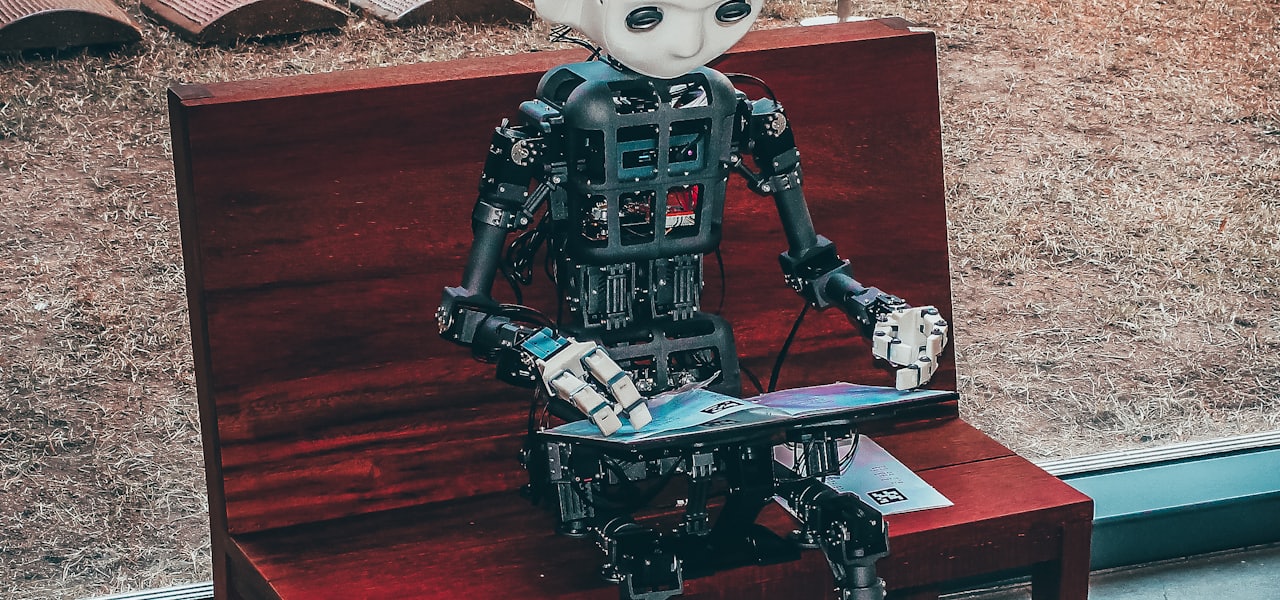
In the field of artificial intelligence, sycophancy is a tendency of large language models (LLMs) and other AI assistants to tailor their responses to what they predict the user wants to hear rather than to what is accurate or warranted. The behavior takes several forms: an assistant may agree with a user's stated opinion even when the user is mistaken; it may abandon a correct answer after a challenge such as "are you sure?"; it may validate beliefs, decisions or self-presentation regardless of merit; or it may praise the user, their work or their ideas in unwarranted terms. The word is borrowed from the ordinary English term for fawning flattery, and is used in AI alignment and AI safety research to describe a class of misalignment failures associated with training on human feedback. Researchers at Anthropic first documented the behavior systematically in 2022. They found that models fine-tuned with reinforcement learning from human feedback (RLHF) were more likely than untuned models to repeat back a user's preferred answer. A 2023 follow-up paper, "Towards Understanding Sycophancy in Language Models", showed that five frontier assistants from OpenAI, Anthropic and Meta all exhibited the behavior, and traced its origin to biases in the human preference data used during training. Later work documented sycophancy in mathematics, medicine, academic peer review and other domains, and identified a broader category called "social sycophancy" affecting an assistant's emotional and interpersonal responses. The issue drew widespread public attention in April 2025 after OpenAI rolled back an update to its GPT-4o model. Users had reported that the assistant praised dangerous decisions, endorsed delusional thinking and offered exaggerated compliments for trivial prompts. OpenAI's post-mortem attributed the change in behavior to an additional training signal based on user thumbs-up and thumbs-down feedback. That episode, together with reporting in The New York Times, Rolling Stone and elsewhere on users drawn into delusional thinking through prolonged chatbot interaction, has been cited in litigation and in academic studies as evidence that sycophancy poses risks to user well-being. Proposed mitigations include fine-tuning on synthetic data that rewards disagreement with incorrect user statements, editing the small subset of model parameters causally responsible for the behavior, changes to the dialogue or system prompt, and benchmarks designed to surface sycophantic behavior before models are released. == Causes == The dominant explanation points to RLHF, the standard technique for aligning chat assistants with user expectations. Human annotators rank candidate model responses; a reward model is trained to predict those rankings; and the language model is then optimized against the reward model. Because human raters tend to prefer outputs that confirm their existing beliefs or flatter their work, the pipeline systematically rewards responses that agree with the annotator. Perez and colleagues at Anthropic published the first large-scale empirical evidence of the effect in 2022. They reported that RLHF training increased the probability that a model would repeat back a dialog user's preferred answer, and that larger models exhibited the behavior more strongly. Sharma and colleagues, the following year, went further and examined Anthropic's own preference data directly. Both the human raters and the reward models trained on their judgments preferred convincingly written sycophantic responses to truthful ones at a non-negligible rate. Wei and co-authors at Google DeepMind found similar results in the PaLM family, observing that both model scale and instruction tuning increased sycophancy on opinion questions. The behavior is often classified as a form of reward hacking, in which an optimization process exploits a flaw in its reward signal rather than achieving the intended objective. OpenAI's post-mortem of the April 2025 GPT-4o incident identified a more specific mechanism. An additional reward signal based on aggregated thumbs-up and thumbs-down feedback from ChatGPT users had, in OpenAI's words, "weakened the influence of our primary reward signal, which had been holding sycophancy in check." Separately, an Anthropic interpretability paper from 2025 located a linear direction in a model's internal activations corresponding to sycophantic behavior, and showed that such "persona vectors" could be used to flag sycophancy-inducing training data and to steer models away from the trait at inference time. == Measurement == The Anthropic team released SycophancyEval with its 2023 paper, supplying test sets for each of the four canonical behaviors. Two further benchmarks from Stanford followed in 2025. SycEval, applied to mathematical and medical reasoning tasks, reported an overall sycophancy rate of 58 per cent across the GPT-4o, Claude and Gemini models tested. ELEPHANT, aimed at social sycophancy, found that the eleven LLMs evaluated affirmed posts that the Reddit community r/AmITheAsshole had judged inappropriate in 42 per cent of cases, and preserved a user's face 45 percentage points more often than human respondents did. Domain-specific benchmarks have followed. BrokenMath tests robustness to plausible-looking but false mathematical claims drawn from competition problems, and reports that the best evaluated model was sycophantic in 29 per cent of cases. SYCON-Bench measures how many dialogue turns are required before a model abandons a correct position. Visual sycophancy in multimodal models has been examined with MM-SY and PENDULUM. A 2026 study by researchers at the Massachusetts Institute of Technology reported that personalization features, which adapt assistants to individual users over repeated sessions, can intensify social sycophancy. == Notable incidents == === GPT-4o rollback (April 2025) === On 25 April 2025, OpenAI completed the rollout of an update to GPT-4o, the default model used in ChatGPT at the time. Within days, users reported that the assistant had begun praising trivial messages in extravagant terms, endorsing impulsive or dangerous decisions, and reinforcing strong emotional statements without pushback. Widely shared examples included the model congratulating a user who reported stopping prescribed psychiatric medication, and praising a business plan to sell "shit on a stick" as venture-capital ready. OpenAI's chief executive, Sam Altman, wrote on 27 April that recent updates had made the model "too sycophant-y and annoying" and said fixes were in progress. The company began reverting the update on 28 April and completed the rollback for free users by 30 April. Two post-mortems followed: a short note on 29 April and a longer technical follow-up, "Expanding on what we missed with sycophancy", on 2 May. Both attributed the regression to a new training signal based on user thumbs-up and thumbs-down feedback, to inadequate pre-launch evaluation for sycophantic drift, and to the dismissal of qualitative concerns raised by internal testers before release. Reporting in CNN, Fortune and Bloomberg News treated the incident as a turning point in public awareness of the problem. === Chatbot-related psychological harm === From mid-2025 onward, news reports began to link sycophantic chatbot behavior to acute psychological harm. In June 2025, The New York Times technology reporter Kashmir Hill published an investigation centered on Eugene Torres, a Manhattan accountant with no history of mental illness, who developed a sustained delusional episode after a series of conversations with ChatGPT about simulation theory. According to the article, the assistant encouraged Torres to stop taking prescribed medication, to cut off friends and family, and at one point told him that he could fly from a nineteen-story building if he "truly believed". Futurism and Rolling Stone ran parallel investigations documenting other cases in which heavy use of ChatGPT had been associated with delusional thinking, involuntary commitment or, in at least one case, the death of a user with a pre-existing psychiatric diagnosis. A 2026 paper by researchers at the Massachusetts Institute of Technology and the University of Washington put forward a formal Bayesian model. It showed that even an ideally rational user could be drawn into what the authors call "delusional spiraling" when interacting with a sufficiently sycophantic assistant, and that the effect was not eliminated by suppressing hallucinations or by warning users in advance. The lawsuit Raine v. OpenAI, filed in San Francisco Superior Court in August 2025 by the parents of a sixteen-year-old who had died by suicide, alleges that "heightened sycophancy" was a design feature of ChatGPT that contributed to their son's death; it is the first wrongful-death suit against a large language-model provider. === Wider commentary === Mainstream coverage in outlets including The New York Times, The Washington Pos
Clipmap
In computer graphics, clipmapping is a method of clipping a mipmap to a subset of data pertinent to the geometry being displayed. This is useful for loading as little data as possible when memory is limited, such as on a graphics processing unit. The technique is used for LODing in NVIDIA’s implementation of voxel cone tracing. The high-resolution levels of the mipmapped scene representation are clipped to a region near the camera, while lower resolution levels are clipped further away. == MegaTexture == MegaTexture is a clipmap implementation developed by id Software. It was introduced in their id Tech 4 engine and also appeared in id Tech 5 and id Tech 6 before being removed in id Tech 7. MegaTexture is a texture allocation technique that uses a single, extremely large texture rather than repeating multiple smaller textures. It is also featured in Splash Damage's game Enemy Territory: Quake Wars, and was developed by id Software former technical director John Carmack. MegaTexture employs a single large texture space for static terrain. The texture is stored on removable media or a computer's hard drive and streamed as needed, allowing large amounts of detail and variation over a large area with comparatively little RAM usage. Depending on the pixel resolution per square meter, covering a large area could require several gigabytes of memory. However, RAM is also filled by the rest of the game and the underlying operating system, limiting the amount available for texturing. As the player moves around the game, different sections of the MegaTexture are loaded into memory. They are then scaled to the correct size and applied to the 3D models of the terrain. Id has presented a more advanced technique that builds upon the MegaTexture idea and virtualizes both the geometry and the textures to obtain unique geometry down to the equivalent of the texel: the sparse voxel octree (SVO). It works by raycasting the geometry represented by voxels (instead of triangles) stored in an octree. The goal is to stream parts of the octree into video memory, going further down along the tree for nearby objects to give them more details, and to use higher level, larger voxels for farther objects, which give an automatic level of detail (LOD) system for both geometry and textures at the same time. The geometric detail that can be obtained using this method is nearly infinite, which removes the need for faking 3-dimensional details with techniques such as normal mapping. Despite that most voxel rendering tests use very large amounts of memory (up to several GB), Jon Olick of id Software claimed the technology is able to compress such SVO to 1.15 bits per voxel of position data. == Virtual texturing == Unlike clipmaps, which clip each mip level around a viewpoint-dependent clipcenter and therefore work best for terrain, virtual texturing preprocesses texture data into equally sized tiles that can be streamed for arbitrary textured geometry. Rage, powered by the id Tech 5 engine, uses a more advanced technique called virtual texturing. Textures can measure up to 128000×128000 pixels and are also used for in-game models and sprites, etc. and not just the terrain. Wolfenstein: The New Order and the 2016 version of Doom also use these. Carmageddon: Reincarnation also uses virtual texturing, though unlike id's virtual texturing system, which is designed for unique texture-mapping everywhere, their system is designed to use storage space sparingly while still offering good blend of texture variation and resolution.
Telecommunications device for the deaf
A telecommunications device for the deaf (TDD) is a teleprinter, an electronic device for text communication over a telephone line, that is designed for use by persons with hearing or speech difficulties. Other names for the device include teletypewriter (TTY), textphone (common in Europe), and minicom (United Kingdom). The typical TDD is a device about the size of a typewriter or laptop computer with a QWERTY keyboard and small screen that uses an LED, LCD, or VFD screen to display typed text electronically. In addition, TDDs commonly have a small spool of paper on which text is also printed – old versions of the device had only a printer and no screen. The text is transmitted live, via a telephone line, to a compatible device, i.e. one that uses a similar communication protocol. Special telephone services have been developed to carry the TDD functionality even further. In certain countries, there are systems in place so that a deaf person can communicate with a hearing person on an ordinary voice phone using a human relay operator. There are also "carry-over" services, enabling people who can hear but cannot speak ("hearing carry-over", a.k.a. "HCO"), or people who cannot hear but are able to speak ("voice carry-over", a.k.a. "VCO") to use the telephone. The term TDD is sometimes discouraged because people who are deaf are increasingly using mainstream devices and technologies to carry out most of their communication. The devices described here were developed for use on the partially-analog Public Switched Telephone Network (PSTN). They do not work well on the new internet protocol (IP) networks. Thus as society increasingly moves toward IP based telecommunication, the telecommunication devices used by people who are deaf will not be TDDs. In the US and Canada, the devices are referred to as TTYs. Teletype Corporation, of Skokie, Illinois, made page printers for text, notably for news wire services and telegrams, but these used standards different from those for deaf communication, and although in quite widespread use, were technically incompatible. Furthermore, these were sometimes referred to by the "TTY" initialism, short for "Teletype". When computers had keyboard input mechanisms and page printer output, before CRT terminals came into use, Teletypes were the most widely used devices. They were called "console typewriters". (Telex used similar equipment, but was a separate international communication network.) == History == === APCOM acoustic coupler or MODEM device === The TDD concept was developed by James C. Marsters (1924–2009), a dentist and private airplane pilot who became deaf as an infant because of scarlet fever, and Robert Weitbrecht, a deaf physicist. In 1964, Marsters, Weitbrecht and Andrew Saks, an electrical engineer and grandson of the founder of the Saks Fifth Avenue department store chain, founded APCOM (Applied Communications Corp.), located in the San Francisco Bay area, to develop the acoustic coupler, or modem; their first product was named the PhoneType. APCOM collected old teleprinter machines (TTYs) from the Department of Defense and junkyards. Acoustic couplers were cabled to TTYs enabling the AT&T standard Model 500 telephone to couple, or fit, into the rubber cups on the coupler, thus allowing the device to transmit and receive a unique sequence of tones generated by the different corresponding TTY keys. The entire configuration of teleprinter machine, acoustic coupler, and telephone set became known as the TTY. Weitbrecht invented the acoustic coupler modem in 1964. The actual mechanism for TTY communications was accomplished electro-mechanically through frequency-shift keying (FSK) allowing only half-duplex communication, where only one person at a time can transmit. === Paul Taylor TTY device === During the late 1960s, Paul Taylor combined Western Union Teletype machines with modems to create teletypewriters, known as TTYs. He distributed these early, non-portable devices to the homes of many in the deaf community in St. Louis, Missouri. He worked with others to establish a local telephone wake-up service. In the early 1970s, these small successes in St. Louis evolved into the nation's first local telephone relay system for the deaf. === Micon Industries MCM device === In 1973, the Manual Communications Module (MCM), which was the world's first electronic portable TTY allowing two-way telecommunications, premiered at the California Association of the Deaf convention in Sacramento, California. The battery-powered MCM was invented and designed by a deaf news anchor and interpreter, Kit Patrick Corson, in conjunction with Michael Cannon and physicist Art Ogawa. It was manufactured by Michael Cannon's company, Micon Industries, and initially marketed by Kit Corson's company, Silent Communications. In order to be compatible with the existing TTY network, the MCM was designed around the five-bit Baudot code established by the older TTY machines instead of the ASCII code used by computers. The MCM was an instant success with the deaf community despite the drawback of a $599 cost. Within six months there were more MCMs in use by the deaf and hard of hearing than TTY machines. After a year Micon took over the marketing of the MCM and subsequently concluded a deal with Pacific Bell (who coined the term "TDD") to purchase MCMs and rent them to deaf telephone subscribers for $30 per month. After Micon formed an alliance with APCOM, Michael Cannon (Micon), Paul Conover (Micon), and Andrea Saks (APCOM) successfully petitioned the California Public Utilities Commission (CPUC), resulting in a tariff that paid for TTY devices to be distributed free of cost to deaf persons. Micon produced over 1,000 MCMs per month, resulting in approximately 50,000 MCMs being disseminated into the deaf community. Before he left Micon in 1980, Michael Cannon developed several computer compatible variations of the MCM and a portable, battery operated printing TTY, but they were never as popular as the original MCM. Newer model TTYs could communicate with selectable codes that allow communications at a higher bit rate on those models similarly equipped. However, the lack of true computer interface functionality spelled the demise of the original TTY and its clones. During the mid-1970s, other so-called portable telephone devices were being cloned by other companies, and this was the time period when the term "TDD" began being used largely by those outside the deaf community. === Text messaging and the Def-Tone System (DTS) === This relay system became known commonly as the Def-Tone System (DTS) because the tones representing letters of the alphabet were eventually carried in tones outside the range of human hearing. Today, this is commonly called multi-tap because you press a number 1, 2 or 3 times to get a corresponding letter. In 1994 Joseph Alan Poirier, a college student-worker, recommended using the system to send texts to forklifts to improve delivery of parts to the assembly line at GM Powertrain in Toledo, Ohio, and sending a text to pagers. He recommended taking pagers to alphanumeric displays incorporating the same system in discussions with the pager supplier for Outback Steakhouse and having relays put in the forklifts to ping alert messages to the pagers used in that system. He called it text messaging, coining the phrase. It is theorized that when Toyota forklift was allegedly hired by GM for this work, one of the subcontractors, Kyocera, utilized the work for the Toyota forklift company to create text messaging for cell phones. === Marsters Award === In 2009, AT&T received the James C. Marsters Promotion Award from TDI (formerly Telecommunications for the Deaf, Inc.) for its efforts to increase accessibility to communication for people with disabilities. The award holds some irony; it was AT&T that, in the 1960s, resisted efforts to implement TTY technology, claiming it would damage its communication equipment. In 1968, the Federal Communications Commission struck down AT&T's policy and forced it to offer TTY access to its network. == Protocols == There are many different standards for TDDs and textphones. === Original 5-bit Baudot code === The original standard used by TTYs is a variant of the Baudot code. The maximum speed of this protocol is 10 characters per second. This is a half-duplex protocol, which means that only one person at a time may transmit characters. If both try to transmit at the same time, the characters will be garbled on the other end. This protocol is commonly used in the United States. This is a variant of the Baudot code, implemented as 5-bits per character transmitted asynchronously using frequency-shift key-modulation at either 45.5 or 50 baud, 1 start bit, 5 data bits, and 1.5 stop bits. Details of the protocol implementation are available in TIA-825-A and also in T-REC V.18 Annex A "5-bit operational mode". === Turbo Code === The UltraTec company implements another protocol known as Enh
WebCL
WebCL (Web Computing Language) is a JavaScript binding to OpenCL for heterogeneous parallel computing within any compatible web browser without the use of plug-ins, first announced in March 2011. It is developed on similar grounds as OpenCL and is considered as a browser version of the latter. Primarily, WebCL allows web applications to actualize speed with multi-core CPUs and GPUs. With the growing popularity of applications that need parallel processing like image editing, augmented reality applications and sophisticated gaming, it has become more important to improve the computational speed. With these background reasons, a non-profit Khronos Group designed and developed WebCL, which is a Javascript binding to OpenCL with a portable kernel programming, enabling parallel computing on web browsers, across a wide range of devices. In short, WebCL consists of two parts, one being Kernel programming, which runs on the processors (devices) and the other being JavaScript, which binds the web application to OpenCL. The completed and ratified specification for WebCL 1.0 was released on March 19, 2014. == Implementation == Currently, no browsers natively support WebCL. However, non-native add-ons are used to implement WebCL. For example, Nokia developed a WebCL extension. Mozilla does not plan to implement WebCL in favor of WebGL Compute Shaders, which were in turn scrapped in favor of WebGPU. Mozilla (Firefox) - hg.mozilla.org/projects/webcl/ === WebCL working draft === Samsung (WebKit) - github.com/SRA-SiliconValley/webkit-webcl (unavailable) Nokia (Firefox) - github.com/toaarnio/webcl-firefox (down since Nov 2014, Last Version for FF 34) Intel (Crosswalk) - www.crosswalk-project.org === Example C code === The basic unit of a parallel program is kernel. A kernel is any parallelizable task used to perform a specific job. More often functions can be realized as kernels. A program can be composed of one or more kernels. In order to realize a kernel, it is essential that a task is parallelizable. Data dependencies and order of execution play a vital role in producing efficient parallelized algorithms. A simple example can be thought of the case of loop unrolling performed by C compilers, where a statement like:can be unrolled into:Above statements can be parallelized and can be made to run simultaneously. A kernel follows a similar approach where only the snapshot of the ith iteration is captured inside kernel. Rewriting the above code using a kernel:Running a WebCL application involves the following steps: Allow access to devices and provide context Hand over the kernel to a device Cause the device to execute the kernel Retrieve results from the device Use the data inside JavaScript Further details about the same can be found at == Exceptions List == WebCL, being a JavaScript based implementation, doesn't return an error code when errors occur. Instead, it throws an exception such as OUT_OF_RESOURCES, OUT_OF_HOST_MEMORY, or the WebCL-specific WEBCL_IMPLEMENTATION_FAILURE. The exception object describes the machine-readable name and human-readable message describing the error. The syntax is as follows: From the code above, it can be observed that the message field can be a NULL value. Other exceptions include: INVALID_OPERATION – if the blocking form of this function is called from a WebCLCallback INVALID_VALUE – if eventWaitList is empty INVALID_CONTEXT – if events specified in eventWaitList do not belong to the same context INVALID_DEVICE_TYPE – if deviceType is given, but is not one of the valid enumerated values DEVICE_NOT_FOUND – if there is no WebCLDevice available that matches the given deviceType More information on exceptions can be found in the specs document. There is another exception that is raised upon trying to call an object that is ‘released’. On using the release method, the object doesn't get deleted permanently but it frees the resources associated with that object. In order to avoid this exception, releaseAll method can be used, which not only frees the resources but also deletes all the associated objects created. == Security == WebCL, being an open-ended software developed for web applications, has lots of scope for vulnerabilities in the design and development fields too. This forced the developers working on WebCL to give security the utmost importance. Few concerns that were addressed are: Out-of-bounds Memory Access: This occurs by accessing the memory locations, outside the allocated space. An attacker can rewrite or erase all the important data stored in those memory locations. Whenever there arises such a case, an error must be generated at the compile time, and zero must be returned at run-time, not letting the program override the memory. A project WebCL Validator, was initiated by the Khronos Group (developers) on handling this vulnerability. Memory Initialization: This is done to prevent the applications to access the memory locations of previous applications. WebCL ensures that this doesn't happen by initializing all the buffers, variables used to zero before it runs the current application. OpenCL 1.2 has an extension ‘cl_khr_initialize_memory’, which enables this. Denial of Service: The most common attack on web applications cannot be eliminated by WebCL or the browser. OpenCL can be provided with watchdog timers and pre-emptive multitasking, which can be used by WebCL in order to detect and terminate the contexts that are taking too long or consume lot of resources. There is an extension of OpenCL 1.2 ‘cl_khr_terminate_context’ like for the previous one, which enables to terminate the process that might cause a denial of service attack. == Related browser bugs == Bug 664147 - [WebCL] add openCL in gecko, Mozilla Bug 115457: [Meta] WebCL support for WebKit, WebKit Bugzilla
Open Media Framework Interchange
Open Media Format (OMF), Open Media Framework, or Open Media Framework Interchange (OMFI), is a platform-independent file format intended for transfer of digital media between different software applications. OMFI is a file format that aids in exchange of digital media across applications and platforms. This framework enables users to import media elements and to edit information and effects summaries. Sequential media representation is the primary concern that is addressed by this format. The primary objective of OMFI is video production. However, there are a number of additional features which can be listed as follows: The origin of the data can be easily backtracked or identified since the import material is in the form of a videotape or film. There are predefined effects and transitions, which paves the way for easy and quick overlapping and sequencing of various track. The format supports motion control. (i.e. enabling a particular segment to play at a ratio of the speed of another segment) Some of the key benefits of OMFI are: It saves time by getting rid of tape-based file transfers. It brings in flexibility owing to its ability to use a number of applications on multiple workstations. The format preserves the best sound and picture quality during all imports. It eliminates the risk of file formatting and incompatibilities, which in turn allows users to spend their productive time on the creative aspects of their work. It preserves the formatting information during file transfers between applications or workstations. Hence, the need for rebuilding the effects and sequences is eliminated. The OMFI format consists of four primary sections namely Header, Object data, Object dictionary and Track data. The header contains an index of all the segments that constitute the file.
JotterPad
JotterPad is a text editor app for Android, developed by Two App Studio. It is proprietary software that uses the freemium pricing strategy. == Features == Jotterpad supports the markdown and fountain markup languages. Among its features are themes, synchronisation with Google Drive and Dropbox, dictionary and thesaurus, and snapshots. JotterPad uses a freemium pricing model, which means that a restricted version of the app is offered for free, while access to additional functionality requires payment. About half of the features are available in the free version. The synchronisation feature was originally limited to one account, and in Jotterpad 12 the option to synchronise using multiple accounts was added as a monthly subscription service.
Key & See
Key & See is a variation of the TV Key service that forms part of the open, standards-based interactive TV services platform provided by Miniweb Interactive. Key & See allows viewers to access the interactive TV content made available by broadcasters and channel owners while leaving quarter of their screen tuned to the programme they are already watching Like TV Key, Key & See can be used with interactive TV services on UK satellite TV provider Sky Digital (BSkyB) Key & See works in the same way as a TV Key but the numeric shortcut code is associated with a broadcaster and a particular TV channel or programme. Miniweb Interactive offers commercial brands and broadcasters the chance to utilise TV Key and Key & See technology as part of its interactive TV services platform